Have you ever tried to learn a song that uses a progression of barre chords that are spread out all over the neck of your guitar? The faster the tempo the more likely it is that you will over or under shoot the correct frets.
While conquering this problem is often a matter of diligent slow-speed practice sessions, there is a fantastic alternative trick that consolidates all of these chords into one small section of the neck called the box. For the rest of this article click here: Barre Chord Lesson
Showing posts with label how to. Show all posts
Showing posts with label how to. Show all posts
Saturday, July 12, 2008


Friday, May 30, 2008
Instantly Play 12 Guitar Chords By Learning Just One Movable Shape
Learning movable chord shapes is a fairly simple concept. Yet, they can dramatically increase the number of chords and therefore the number of songs at your disposal.
Like many guitar students, my beginner days were spent memorizing about 10 open chords. You know, the ones found at the first 4 frets at the far end of the guitar neck.
When I gradually learned to move smoothly from chord to chord a whole world of songs were suddenly at my fingertips. For the first time I felt like a real guitar player.
It had taken quite a while to memorize the open chords and I just couldn’t imagine how anyone could learn and remember all the chords that reside at the other 18 or so frets on the guitar neck. It just didn’t make much sense. There seemed to be no rhyme or reason for why certain notes were fingered on certain strings. Each and every chord just had to be memorized… or so I thought.... click here for the rest of the article on Movable Barre Chord Shapes
Like many guitar students, my beginner days were spent memorizing about 10 open chords. You know, the ones found at the first 4 frets at the far end of the guitar neck.
When I gradually learned to move smoothly from chord to chord a whole world of songs were suddenly at my fingertips. For the first time I felt like a real guitar player.
It had taken quite a while to memorize the open chords and I just couldn’t imagine how anyone could learn and remember all the chords that reside at the other 18 or so frets on the guitar neck. It just didn’t make much sense. There seemed to be no rhyme or reason for why certain notes were fingered on certain strings. Each and every chord just had to be memorized… or so I thought.... click here for the rest of the article on Movable Barre Chord Shapes
Wednesday, May 14, 2008
REVIEW: Jamorama Guitar Lessons Are Surprisingly Innovative At A Truly Low Cost

Ranked 8.5 out of 10
My top recommendations always lean towards guitar instruction programs that are all-video. They offer an easier method of communicating lots of subtle information. Having said that, I feel that although Jamorama is a downloadable written lesson program, it is by far the best in its class. The primary reason for this is because of the quality audio and video snippets added to enhance the learning experience.
The lessons are logical, thorough and perfect for the rank beginner all the way through advanced intermediate players. The course has some of the most innovative software programs and games for taking the mundane parts of learning the guitar and making them fun.
At only $39.95, Jamorama is perfect for someone that does not wish to spend $150- $200 for an all-video program. It is an excellent, low risk way to get started with learning to play guitar. For these reasons, I recommend, with out hesitation, the Jamorama guitar lesson program.
Click here for my complete written review of the Jamorama Guitar Lesson Program.
Friday, November 16, 2007
Guitar Maintenance: Is Your Guitar Slowly Dying Of Thirst?
Do you sometimes finger a fret on your guitar and hear a buzzing sound or even no sound? If you answered yes then your guitar may be seriously, even irreversibly dehydrated and possibly headed for the graveyard.
This is the story of how I became a true guitar hero by saving the life of my severely dehydrated guitar.
My Sad Story
Last Winter I remember grabbing my guitar for a typical daily goof around ...ah... I mean, serious practice session and found that my B string made an annoying buzzing sound from frets 4 - 9. I wondered why it was suddenly doing this when just a few days before it was fine. I decided to ignore the problem and hope that it would disappear on its own.
In just a few more days the B string stopped buzzing but frets 4-9 now wouldn't play anything. To make matters worse the G string had now started to buzz.
Initially I thought that some of my frets were coming loose and needed to be repaired. Then an awful thought hit me. Had my guitar become warped because of the extremely low humidity produced by the typical winter weather? Was my precious guitar now ruined?
I also wondered that if my guitar really was dehydrated, was it possible to re-hydrate it and would this reverse the damage? Fortunately, in my case, the answer was yes. My guitar had not yet reached the point of no return. It was indeed possible to restore the sound that I had grown to love. The following describes are the steps I took:
Measuring The Humidity Of My Home
With a little research I learned that most acoustic guitars need an environment that has a relative humidity level of 45% to 55%. An inexpensive, non-digital, device called a hygrometer was purchased at my local hardware store for under $10 dollars (USD).
It was then mounted in the room where I usually kept my guitar. For reasonable accuracy, I selected a wall that did not have an exposure to the outside cold. I also avoided wall locations that were too near the common humid air blasts of the bathroom and kitchen.
After mounting the hygrometer and letting it acclimate for 24 hours, I discovered that my guitar had been constantly exposed, un-cased, to a relative humidity of only 24%. Now that I had confirmed that my guitar was indeed dried out, it was time to find a way to return the lost moisture.
How I Re-Humidified My Guitar
I remembered seeing a humidifier that was designed specifically for a guitar. It had a ½" diameter, foot long, green rubber tube with about 100 small holes poked along its length. Inside the tube was a yellow sponge material. Both ends of the tube contained black plastic plugs with one end attached to a string. The other end of the string was attached to a black plastic disc approximately the size of the guitar sound hole.
The idea was to cover the sound hole with the disc then dangle the water soaked tube inside the body of the guitar. As the moisture inside the tube evaporates it would re-hydrate the wood causing it to return to its previously un-warped shape. The plastic disc was designed to prevent the evaporating moisture from escaping the inside of the body of the guitar.
So That's The Theory Anyway But How Did It Work in Reality?
In about 24 hours, a simple visual inspection of my guitar revealed that the partial re-hydrating of my guitar caused the wood to begin to move back to its pre-warped state. The bridge, the device holds the ends of the guitar strings near the sound hole, had rotated in such a way that it raised the guitar strings slightly higher off the frets and therefore began to eliminate the buzzing or dead sounds at certain frets.
After 2 days I noticed that the sound of the B and G strings had continued to improve. After a total of 4 days of checking and remoistening the humidifier's sponge, it had improved even more but, the buzz still had not completely gone away. At this point I wondered if the tube-in-the-body method was too slow and didn't allow the entire guitar to properly re-hydrate.
Bringing Out The Big Guns: Satisfying The Need For More Moisture
I decided to use a standard table top room humidifier to increase the relative humidity in the entire living room. I bought a Sunbeam Ultrasonic Model 705 at a local Pharmacy. Its capacity was about 5 quarts of distilled water which turned out to be just about the amount of cool, distilled water vapor that it could dissipate in 24 hours.
It took about 4 days to increase the room's relative humidity from 24% to 43%. During this time I propped my guitar on a stand outside of its case in the same room. I had also removed the humidifier that was inside the guitar. At the end of these 4 days the buzzing and dead fret sounds had completely gone away. What a relief, my guitar hadn't been dead after all - just very sick.
The bottom line for Guitar Humidity Control
1. Don't expose your guitar to extremely dry environments for extended periods. This includes the trunk of your car during extreme cold or extreme hot weather. While a hard shell case or a gig bag can offer some protection they cannot prevent damage in extreme conditions.
2. If your guitar is primarily stored and used in one room of your home then humidify the entire room in the driest seasons. Monitor the room's humidity using an inexpensive hygrometer available at most hardware stores. Target 45% to 55% relative humidity.
3. If you cannot control the relative humidity of your home then make sure to keep your guitar in its case a much as possible. Use an in-guitar or in-guitar-case type of humidifier.
Think prevention. Don't wait until your guitar is in trouble before you start to worry about humidity control. It is possible to dry out a guitar to the point where it cannot be fixed. Remember, it's never fun to attend a guitar funeral.
About The Author: John Mackinnon started taking guitar lessons over 40 years ago and still enjoys the learning process. His website http://www.CompareGuitarLessons.com is dedicated to providing guitar player reviews of DVD based and online guitar lesson programs. He also offers guitar related articles, guitar resource links, a free newsletter.
This is the story of how I became a true guitar hero by saving the life of my severely dehydrated guitar.
My Sad Story
Last Winter I remember grabbing my guitar for a typical daily goof around ...ah... I mean, serious practice session and found that my B string made an annoying buzzing sound from frets 4 - 9. I wondered why it was suddenly doing this when just a few days before it was fine. I decided to ignore the problem and hope that it would disappear on its own.
In just a few more days the B string stopped buzzing but frets 4-9 now wouldn't play anything. To make matters worse the G string had now started to buzz.
Initially I thought that some of my frets were coming loose and needed to be repaired. Then an awful thought hit me. Had my guitar become warped because of the extremely low humidity produced by the typical winter weather? Was my precious guitar now ruined?
I also wondered that if my guitar really was dehydrated, was it possible to re-hydrate it and would this reverse the damage? Fortunately, in my case, the answer was yes. My guitar had not yet reached the point of no return. It was indeed possible to restore the sound that I had grown to love. The following describes are the steps I took:
Measuring The Humidity Of My Home
With a little research I learned that most acoustic guitars need an environment that has a relative humidity level of 45% to 55%. An inexpensive, non-digital, device called a hygrometer was purchased at my local hardware store for under $10 dollars (USD).
It was then mounted in the room where I usually kept my guitar. For reasonable accuracy, I selected a wall that did not have an exposure to the outside cold. I also avoided wall locations that were too near the common humid air blasts of the bathroom and kitchen.
After mounting the hygrometer and letting it acclimate for 24 hours, I discovered that my guitar had been constantly exposed, un-cased, to a relative humidity of only 24%. Now that I had confirmed that my guitar was indeed dried out, it was time to find a way to return the lost moisture.
How I Re-Humidified My Guitar
I remembered seeing a humidifier that was designed specifically for a guitar. It had a ½" diameter, foot long, green rubber tube with about 100 small holes poked along its length. Inside the tube was a yellow sponge material. Both ends of the tube contained black plastic plugs with one end attached to a string. The other end of the string was attached to a black plastic disc approximately the size of the guitar sound hole.
The idea was to cover the sound hole with the disc then dangle the water soaked tube inside the body of the guitar. As the moisture inside the tube evaporates it would re-hydrate the wood causing it to return to its previously un-warped shape. The plastic disc was designed to prevent the evaporating moisture from escaping the inside of the body of the guitar.
So That's The Theory Anyway But How Did It Work in Reality?
In about 24 hours, a simple visual inspection of my guitar revealed that the partial re-hydrating of my guitar caused the wood to begin to move back to its pre-warped state. The bridge, the device holds the ends of the guitar strings near the sound hole, had rotated in such a way that it raised the guitar strings slightly higher off the frets and therefore began to eliminate the buzzing or dead sounds at certain frets.
After 2 days I noticed that the sound of the B and G strings had continued to improve. After a total of 4 days of checking and remoistening the humidifier's sponge, it had improved even more but, the buzz still had not completely gone away. At this point I wondered if the tube-in-the-body method was too slow and didn't allow the entire guitar to properly re-hydrate.
Bringing Out The Big Guns: Satisfying The Need For More Moisture
I decided to use a standard table top room humidifier to increase the relative humidity in the entire living room. I bought a Sunbeam Ultrasonic Model 705 at a local Pharmacy. Its capacity was about 5 quarts of distilled water which turned out to be just about the amount of cool, distilled water vapor that it could dissipate in 24 hours.
It took about 4 days to increase the room's relative humidity from 24% to 43%. During this time I propped my guitar on a stand outside of its case in the same room. I had also removed the humidifier that was inside the guitar. At the end of these 4 days the buzzing and dead fret sounds had completely gone away. What a relief, my guitar hadn't been dead after all - just very sick.
The bottom line for Guitar Humidity Control
1. Don't expose your guitar to extremely dry environments for extended periods. This includes the trunk of your car during extreme cold or extreme hot weather. While a hard shell case or a gig bag can offer some protection they cannot prevent damage in extreme conditions.
2. If your guitar is primarily stored and used in one room of your home then humidify the entire room in the driest seasons. Monitor the room's humidity using an inexpensive hygrometer available at most hardware stores. Target 45% to 55% relative humidity.
3. If you cannot control the relative humidity of your home then make sure to keep your guitar in its case a much as possible. Use an in-guitar or in-guitar-case type of humidifier.
Think prevention. Don't wait until your guitar is in trouble before you start to worry about humidity control. It is possible to dry out a guitar to the point where it cannot be fixed. Remember, it's never fun to attend a guitar funeral.
About The Author: John Mackinnon started taking guitar lessons over 40 years ago and still enjoys the learning process. His website http://www.CompareGuitarLessons.com is dedicated to providing guitar player reviews of DVD based and online guitar lesson programs. He also offers guitar related articles, guitar resource links, a free newsletter.
Saturday, August 11, 2007
REVIEW: Blues Guitar Secrets
Question: What do Muddy Waters, Jimmy Page, Eric Clapton, Jimi Hendrix, Eddie Van Halen and John Mayer share in common? 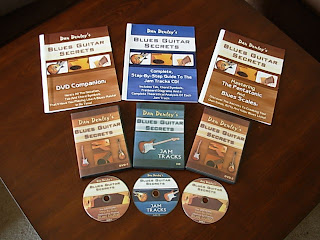
Answer: besides having the distinction of being just a few of the many notable guitarists from the last 60 plus years, they also came from a Blues background or at least had a strong appreciation for the beauty of this mode of music.
Question: what do the musical styles of modern country, rock, metal and pop music share in common?
Answer: they represent some of the many musical genres that are often influenced by the Blues.
Blues Guitar Secrets
Besides the sheer fun of learning to play Blues Guitar it is also a highly recommended way to increase the musical tools that a student can use to write, accompany or solo with many types of music. Learning Blues Guitar can be a smart, educational progression for any guitar student with at least some proficiency with a few basic scales and barre chords.
The Purpose of the Blues Guitar Secrets DVD guitar lesson program is to quickly teach the student:
Is Blues Guitar Secrets For Acoustic Or Electric Guitar Players?
Both. Even though the author begins the course explaining the interesting details of his electric guitar set up, he demonstrates the lessons using a mix of both electric and acoustic guitars. One of the lesson sections is entitled “Acoustic Guitar Blues Riffs”.
The Contents of Blues Guitar Secrets:
(1) Jam Tracks* CD ( included in the Gold Edition only )
(1) Book - DVD Companion: Here’s All The Notation, Tab and Chord Symbols That’ll Have You Playing Like A Blues Master In No Time!”
(1) Book - “Mastering The Pentatonic and Blues Scales: Discover the Secrets To Creating Your Own Solos and Killer Blues Riffs”
(1) Book - Complete Step By Step Guide To The Jam Tracks* CD! - Includes tabs, chord symbols, fretboard diagrams and a complete theoretical analysis of each Jam Track* ( included in the Gold Edition only ).
(1) Progress Tracker
(1) Intro Letter
(1) Step by Step Guide: “How To Use Your Blues Guitar Secrets Course”
A Partial List of The Lessons:
Intro To Blues Guitar
The Pentatonic Minor Movable Scale Patterns in 5 Positions
The Blues Pentatonic Movable Scale patterns
Blues Chord Progressions
Using Minor 7th, Dominant 7th, VI Major 7th, Dominant 9th and Minor 9th chords and scales as well as combination forms.
12-Bar Blues: Open Position Chords
Acoustical Guitar Blues Riffs
Classic Blues Solo Licks
Blues Runs
Solo Practicing Techniques
Adding Bends
Strumming Techniques
Using Syncopation
Bonus Videos
The Positives:
The Bottom Line:
I can, without hesitation, recommend Blues Guitar Secrets for anyone that has basic guitar skills and a desire to learn the essential Blues Guitar basics including how to improvise solos. The course is organized, logical and priced right.
For More Information Or To Purchase Blues Guitar Secrets Click Here
About The Reviewer: John Mackinnon started taking guitar lessons over 40 years ago and still enjoys the learning process. His website, http://www.CompareGuitarLessons.com is dedicated to reviewing dvd based and online guitar lesson programs, offers guitar related articles, guitar resource links and a free newsletter.

Answer: besides having the distinction of being just a few of the many notable guitarists from the last 60 plus years, they also came from a Blues background or at least had a strong appreciation for the beauty of this mode of music.
Question: what do the musical styles of modern country, rock, metal and pop music share in common?
Answer: they represent some of the many musical genres that are often influenced by the Blues.
Blues Guitar Secrets
Besides the sheer fun of learning to play Blues Guitar it is also a highly recommended way to increase the musical tools that a student can use to write, accompany or solo with many types of music. Learning Blues Guitar can be a smart, educational progression for any guitar student with at least some proficiency with a few basic scales and barre chords.
The Purpose of the Blues Guitar Secrets DVD guitar lesson program is to quickly teach the student:
- 12-bar blues in multiple variations
- blues chords and progressions
- blues scales in all positions and keys
- improvising Blues Guitar Solos
What makes a great guitar lesson program?
1. A great instruction program will go beyond the limitations of just reading a book by offering clear audio and video demonstrations of each lesson.
2. The program’s author should ideally possess the following credentials:
- play well themselves
- have played in a band
- toured with a band
- recorded
- must be a gifted and preferably experienced, formally educated guitar teacher.
About The Author Dan Denley:
Dan has an easy to listen to voice coupled with a relaxed style of communicating. He wisely leaves in some playing mistakes while demonstrating the lessons. This is one of the reasons that makes Dan easy-to-relate-to and therefore effective in his teaching.
Who Will Benefit Most From This Guitar Lesson Program?:
Although learning to play basic blues guitar does not require advanced playing ability it does help if you are comfortable with at least one of the movable major or minor scale patterns and some barre chords. However, the Blues Guitar Secrets course will walk you through the Pentatonic and Blues Scales that are the fundamental building blocks of Blues music.
Is Blues Guitar Secrets For Acoustic Or Electric Guitar Players?
Both. Even though the author begins the course explaining the interesting details of his electric guitar set up, he demonstrates the lessons using a mix of both electric and acoustic guitars. One of the lesson sections is entitled “Acoustic Guitar Blues Riffs”.
The Contents of Blues Guitar Secrets:
* Jam Tracks are comprised of short blues songs that create an opportunity to practice rhythm parts or improvising solos while playing with a recorded back up band.
A Partial List of The Lessons:
Intro To Blues Guitar
The Negatives:
It would be nice if this course came with a protective case or organizer to keep all of the materials together. None of these issues are significant but rather are just minor annoyances.
The Positives:
- The author: Dan Denley is experienced at putting together effective guitar instruction courses like “Amazing Guitar Secrets”.
- The author: Dan Denley is an expert, experienced guitarist and a trained educator.
- The author: has a relaxed, organized and easy-to-relate-to style of communicating.
- This course takes the mystery out of how to improvise solos on the guitar.
- This course is easy to follow and understand
- Excellent use of close ups to clarify fingering chords and scales.
- Includes a Jam Track CD for developing essential skills for playing with a band.
- This course uses video, audio and the illustrated written word to appeal to all of the important senses when learning to play guitar. This is especially important if the student’s learning style requires more than reading a book alone can provide.
- This course is primarily a video course with written support materials and not the other way around. I have found that it is less effective and more difficult if you must first read an instruction manual then find a video snippet on your computer that supports the book lesson. I like the much richer experience of watching, listening then emulating a live instructor demonstrating an entire lesson. It is much more effective to use the instruction book only as a means to clarify the video lesson. Blues Guitar Secrets got this part exactly right.
The Price Analysis:
- The Standard Edition is $127 USD, (as of this writing ), and includes all of the items mentioned above in the “Contents” section without the Jam Track CD or Book.
- The Gold Edition is $159 USD (as of this writing ), and includes all of the items mentioned above in the “Contents” section including the Jam Track CD and Book.
Blues Guitar Secrets by Dan Denley contains the equivalent of 6 months to one years worth of guitar lessons if you were to space them out as if you were taking lessons from a local guitar instructor. A local instructor typically will charge anywhere from $20 to $50 per weekly lesson. Your minimum cost, ( not including materials ), at only $20 per lesson for 6 months would be at least $520.
The choice comes down to:
- the Blues Guitar Secrets DVD Program at $127 to $159 or
- a local instructor at $520 to $1040.
Guarantee:
Blues Guitar Secrets comes with a 90 day, unconditional, money-back guarantee.
The Bottom Line:
I can, without hesitation, recommend Blues Guitar Secrets for anyone that has basic guitar skills and a desire to learn the essential Blues Guitar basics including how to improvise solos. The course is organized, logical and priced right.
For More Information Or To Purchase Blues Guitar Secrets Click Here
About The Reviewer: John Mackinnon started taking guitar lessons over 40 years ago and still enjoys the learning process. His website, http://www.CompareGuitarLessons.com is dedicated to reviewing dvd based and online guitar lesson programs, offers guitar related articles, guitar resource links and a free newsletter.
Subscribe to:
Posts (Atom)

 Posts
Posts

